
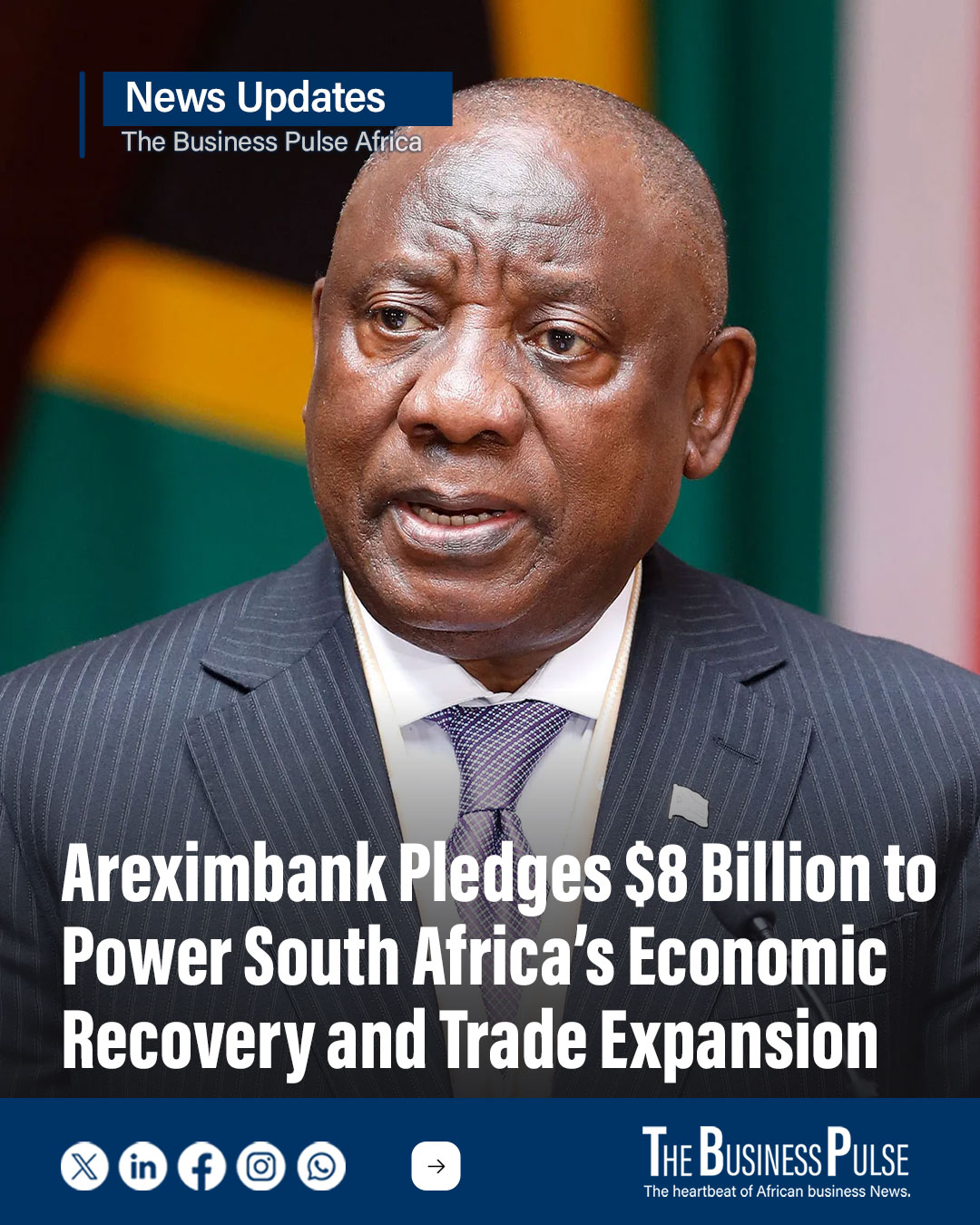
Afreximbank’s $8 Billion SA’s Economic bolster: A Strategic Economic Boost
South Africa has secured a major economic commitment from African Export‑Import Bank, with a $8 billion economic bolster programme designed to accelerate industrial growth, strengthen trade, and support domestic businesses. The announcement came as South Africa formally became a full sovereign member of Afreximbank, gaining Class A shareholder status and greater influence over the bank’s governance and strategic direction. The pact is not just financial but strategic, intended to expand South Africa’s capacity to compete in regional and global markets.
The $8 billion SA’s economic bolster commitment will be mobilised across key sectors including manufacturing, mineral processing, critical infrastructure, and small and medium enterprise (SME) development. Government officials see this partnership as a long-term investment in the country’s economic transformation plans, particularly in growing sectors that can create jobs, support industrialisation, and integrate South African producers into expanded regional value chains under the African Continental Free Trade Area (AfCFTA).
Join our WhatsApp Group
Strengthening Trade and Industrial Growth
One of the primary objectives of the $8 billion SA’s economic bolster initiative is to support local industry and expand South African exports within Africa and beyond. Afreximbank’s financing instruments will be available to a wide range of clients, including governments, financial institutions, private corporations and other eligible entities whose projects align with the bank’s mandate. Access to trade finance is expected to improve the competitiveness of South African firms and reduce exposure to traditional global credit constraints that have hampered growth.
The programme aims to help diversify South Africa’s export base by providing targeted finance for sectors such as automotive components, pharmaceuticals and agro-processing. It also seeks to accelerate the development of value-added industries that can transform raw materials including minerals such as gold, platinum and lithium into higher-value products. For smaller enterprises, especially SME exporters, Afreximbank funds could improve access to trade finance and capacity-building programmes, supporting integration into regional supply chains.
Infrastructure and Energy Investments
A significant component of the $8 billion SA’s economic bolster will focus on critical infrastructure development. Reliable power generation and transmission are seen as essential for industrial growth. Under this programme, Afreximbank may co-finance projects that support South Africa’s transition to a low-carbon economy while addressing persistent energy security challenges. Government officials highlight that infrastructure investments will not only attract further private capital but will also improve manufacturing capabilities and reduce logistical bottlenecks that have constrained economic expansion.
Such infrastructure finance aligns with broader national priorities including expanding renewable energy capacity and modernising transport and industrial corridors. These investments are expected to foster jobs, stimulate demand in local supply chains, and help lay the foundation for more sustained economic growth over the coming decade.
Boosting SMEs and Digital Trade
Key to the $8 billion SA’s economic bolster is support for SMEs, which are viewed as critical engines of employment and innovation. Afreximbank proposals include trade finance facilities, training programmes and initiatives to improve e-commerce readiness. These measures are intended to allow small businesses to tap into digital markets, access financing that has previously been out of reach, and expand offerings regionally.
Supporting SMMEs aligns with the broader strategy of achieving inclusive growth and reducing unemployment, particularly among youth and women. By integrating emerging firms into continental supply chains, the partnership aims to help close financing gaps that have historically limited African SMEs’ expansion and resilience.
Government Strategy and National Priorities
President Cyril Ramaphosa highlighted that South Africa’s accession to Afreximbank and the resulting $8 billion SA’s economic bolster commitment underscores the government’s dedication to industrial development and deeper trade integration within Africa. The partnership is viewed as foundational to establishing a national export-import bank that can deliver tailored financing aligned with South Africa’s industrial priorities.
South African policymakers have emphasised that this cooperation will help crowd in investment and create a more resilient export ecosystem. By collaborating with institutions such as the Industrial Development Corporation, the Development Bank of Southern Africa and leading commercial banks, Afreximbank’s funding is expected to be leveraged alongside domestic and private capital. This blended financing approach is designed to de-risk projects, attract further investment and drive long-term economic competitiveness.
Integration with AfCFTA and Continental Markets
The $8 billion SA’s economic bolster initiative is closely linked with opportunities presented by the African Continental Free Trade Area. By reducing barriers to cross-border trade, African firms including South African exporters can access a market of over a billion consumers. Afreximbank’s financing is intended to help companies take advantage of these markets, enabling them to scale production, improve supply chain integration and compete more effectively across the continent.
Government and bank officials have consistently emphasised that intra-African trade remains underutilised and that focused financial support can unlock value that has historically been missed. Under the new country programme, strategic sectors are expected to benefit from increased access to finance, risk mitigation tools, and technical expertise.
Critics and Structural Challenges
While the $8 billion SA’s economic bolster programme is ambitious, it comes amid ongoing concerns about South Africa’s growth trajectory. Analysts have warned that the country may experience modest growth of around 2% or lower in the near term due to structural constraints including weak investment, labour market rigidities and persistent energy challenges.
Critics argue that unlocking the full potential of the Afreximbank financing will require deeper policy reforms, improvements in governance, and a stronger business environment to ensure that funds are deployed effectively. Ensuring that investments reach their intended beneficiaries, particularly in SME clusters and regional industrial hubs, is viewed as critical for long-term impact.
ALSO READ: Is Africa Being Carved Up Again? Inside the New Global Race for Power, Resources and Influence
Looking Ahead
The $8 billion SA’s economic bolster commitment from Afreximbank marks a major development in South Africa’s economic strategy. By leveraging pan-African financing, the country aims to break through long-standing constraints on industrialisation, expand market access and strengthen its position in both continental and global trade networks.
Implementation over the coming years will be closely watched by investors, policymakers and civil society alike. Success will be measured not only by the volume of financing deployed but by real outcomes: jobs created, industries transformed, and South Africa’s capacity to compete sustainably in Africa’s rapidly evolving economic landscape.
As South Africa moves forward with this partnership, the Afreximbank programme could become a defining feature of the country’s development path, providing a model for how multilateral African institutions can support national and continental economic transformation.

Head of Business Development, Alula Animation. With 10 years in advertising and sustained involvement in startups and entrepreneurship since graduating from business school and the School of Diplomacy and International Relations, Beloved researches and writes practical business analysis and verified job-market insights for The Business Pulse Africa.
Leave a Reply