
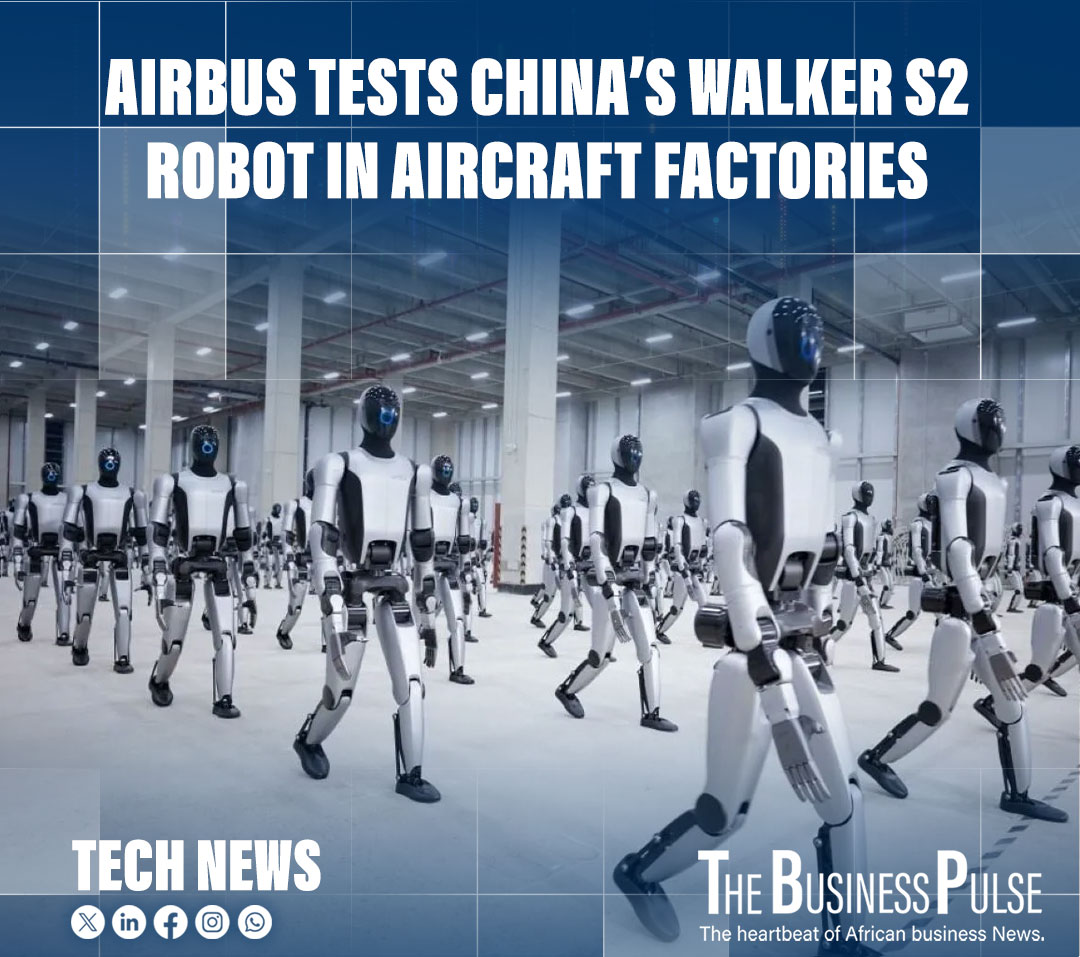
Airbus China Walker S2 robot
Airbus has begun testing a humanoid robot from China in its aircraft manufacturing operations. The robot is made by Chinese robotics company UBTech and is called the Walker S2. Airbus bought the robot and will work with UBTech to study how it can be used in aircraft production. This move shows how the aviation industry is turning to advanced robotics to solve labor shortages, improve safety, and raise productivity. The partnership centers on the Airbus China Walker S2 robot and how it may support workers in factories where accuracy and safety are critical.
What Airbus is trying to achieve
Aircraft manufacturing is complex. It involves thousands of parts, strict quality checks, and long production timelines. Airbus is under pressure to increase output while keeping costs under control. It also faces a shortage of skilled labor in many countries. The company is therefore exploring automation beyond traditional factory machines.
Join our WhatsApp Group
The Airbus China Walker S2 robot is being tested as a helper to human workers. Airbus wants to see if a humanoid robot can move through factory spaces, handle tools, and perform repetitive physical tasks without needing major changes to factory layouts.
Unlike fixed robots that stay in one place, this robot can walk and use its hands. That makes it suitable for tasks that change location within the factory.
What the Walker S2 robot can do
The Walker S2 is a full-size humanoid robot built for industrial work. It is about 5.8 feet tall and weighs roughly the same as an adult person. It can carry loads of up to 33 pounds. It uses cameras, sensors, and artificial intelligence to move and understand its surroundings.
The robot has hands that can grip tools and parts. It can climb steps, walk across factory floors, and position itself near workstations. It can also detect obstacles and adjust its movements.
One key feature of the Airbus China Walker S2 robot is its battery system. The robot can remove and replace its own battery without human help. This allows it to operate for long periods without stopping for charging. Airbus is interested in this because aircraft factories run for many hours each day.
Why Airbus chose a Chinese robot
China has invested heavily in robotics and automation. Companies like UBTech have spent years developing robots for factories. UBTech already supplies robots to large manufacturers in electronics and automotive sectors.
Airbus selected UBTech because the Walker S2 has already been tested in industrial settings. UBTech reports that more than 1,000 Walker S2 robots are in use across different companies. This gives Airbus confidence that the robot is not just a research project but a working product.
The Airbus China Walker S2 robot also matches Airbus’ goal of finding flexible automation tools rather than fixed machines. This type of robot can be reprogrammed for new tasks as factory needs change.
ALSO READ: Themba Gorimbo and the backlash over family and identity
How the robot will be used in Airbus factories
Airbus has not said exactly which tasks the robot will perform at first. The initial phase is about testing and learning. Engineers will study how the robot moves in factory spaces and how well it handles tools and parts.
Likely early tasks include:
• Carrying parts between workstations
• Holding components during assembly
• Performing simple repetitive movements
• Supporting inspection processes
These are tasks that take time and physical effort from workers but do not require complex judgment. Airbus wants the Airbus China Walker S2 robot to assist workers, not replace them.
The robot will be used in controlled environments first. Airbus will test safety systems and how the robot reacts to human movement nearby.
Why this matters for aircraft production
Aircraft production is slow and costly. Any small delay can affect delivery schedules and cash flow. Airbus has faced delays in recent years due to supply chain problems and worker shortages.
Robots like the Airbus China Walker S2 robot may help keep production lines moving. They can work for long hours without fatigue. They also provide consistent performance for repetitive tasks.
If successful, this technology could reduce injury risks for workers who handle heavy parts. It could also reduce errors caused by tiredness or distraction.
Over time, this may improve Airbus’ ability to meet airline demand and compete with rivals.
Why this is not full automation
This project does not mean robots will build airplanes alone. Aircraft assembly still requires skilled human workers. Many tasks involve judgment, adjustment, and experience.
The robot is designed to assist rather than replace. It works best in jobs where steps are clear and repeatable.
Airbus has said the goal is cooperation between humans and machines. The Airbus China Walker S2 robot is part of this approach. It is a tool that extends human capacity rather than removing human involvement.
ALSO READ: A Deep Dive into the Top 10 African economies and GDP growth Projections for 2026
Business reasons behind the partnership
This partnership is also about long term business planning. Airbus wants to protect itself from labor shortages and rising costs. Many factory workers are aging. Training new skilled workers takes time.
Robots can help fill gaps where hiring is difficult. They can also help maintain output during peak demand.
From UBTech’s side, working with Airbus helps prove its product in a demanding industry. Aviation has strict standards. If the robot works there, it becomes more attractive to other buyers.
This makes the Airbus China Walker S2 robot a business showcase for UBTech.
Impact on workers
Some workers fear robots will take jobs. Airbus has said this is not the purpose. The focus is on heavy, repetitive, or risky tasks.
The company expects workers to move toward supervision, programming, and quality control roles. This requires new skills. Airbus may need to invest in worker training to match this shift.
The robot may reduce physical strain. Tasks that cause back or joint injuries can be given to machines instead.
This could improve safety and reduce sick leave.
Why humanoid robots are different from factory robots
Traditional factory robots are fixed in place. They work well for specific tasks like welding or painting. But they cannot move around freely.
Humanoid robots like the Airbus China Walker S2 robot can walk and use hands. This allows them to move between tasks without changing the factory layout.
Factories built for humans can be used by humanoid robots with fewer changes. This reduces installation costs.
It also allows one robot to be assigned to different tasks over time.
ALSO READ: Standard Chartered Botswana Exit: The Harsh Hidden Truth
Risks and challenges
There are still many challenges.
First, reliability. The robot must work without frequent errors. Aircraft factories cannot afford breakdowns.
Second, safety. The robot must not collide with workers or damage parts.
Third, cost. These robots are expensive. Airbus must prove they save more money than they cost.
Fourth, software. The robot must be trained to understand tools and parts correctly.
The Airbus China Walker S2 robot must pass many tests before being used widely.
Why battery swapping matters
The battery swapping feature is important. Many robots must stop for hours to recharge. This reduces productivity.
The Walker S2 can replace its own battery. This allows continuous operation if spare batteries are available.
For Airbus, this means robots can work through long shifts. This helps justify the investment.
It also reduces the need for special charging rooms or long downtime.
China’s role in robotics
China is pushing to become a leader in robotics and artificial intelligence. It supports research and large scale manufacturing of robots.
UBTech is part of this push. It focuses on humanoid robots that can work alongside people.
By working with Airbus, China shows that its robotics industry can supply global companies.
The Airbus China Walker S2 robot is therefore not only a factory tool but also a sign of China’s growing role in advanced manufacturing.
What success would look like
Success would mean the robot:
• Works safely near humans
• Handles tools correctly
• Reduces worker strain
• Operates for long hours
• Fits into existing factory processes
If these goals are met, Airbus may expand its use to other factories.
The company may also request changes or improvements from UBTech based on test results.
What this means for other industries
If this project works, other industries will pay attention. Car makers, ship builders, and electronics firms face similar problems.
They also need flexible robots that can work in human spaces.
The Airbus China Walker S2 robot could become a model for how humanoid robots enter industrial work.
Long term outlook
This project is still in an early stage. Airbus is testing, not committing fully.
But it shows a clear direction. Manufacturing is moving toward mixed human-robot teams.
The cost of robots is falling. Their ability is rising. This makes them more practical for real work.
If successful, Airbus will likely invest in more units and expand tasks.
This would change how factories are designed and staffed.
Final assessment
The partnership between Airbus and UBTech is a careful business experiment. Airbus is not rushing. It is studying how humanoid robots can help in real production.
The Airbus China Walker S2 robot represents a new type of factory tool. It can walk, lift, and use its hands like a human. It can work long hours without rest.
This does not mean people will disappear from factories. It means work will change. Machines will take heavy and repetitive tasks. Humans will manage, inspect, and guide.
For Airbus, this is about staying competitive. For UBTech, it is about proving its technology in one of the hardest industries.
The results of this test will influence how future factories look. It may also influence how workers are trained.
This project shows that robotics is no longer just about machines in cages. It is about machines working next to people.
The Airbus China Walker S2 robot is an early sign of that future.
Leave a Reply