
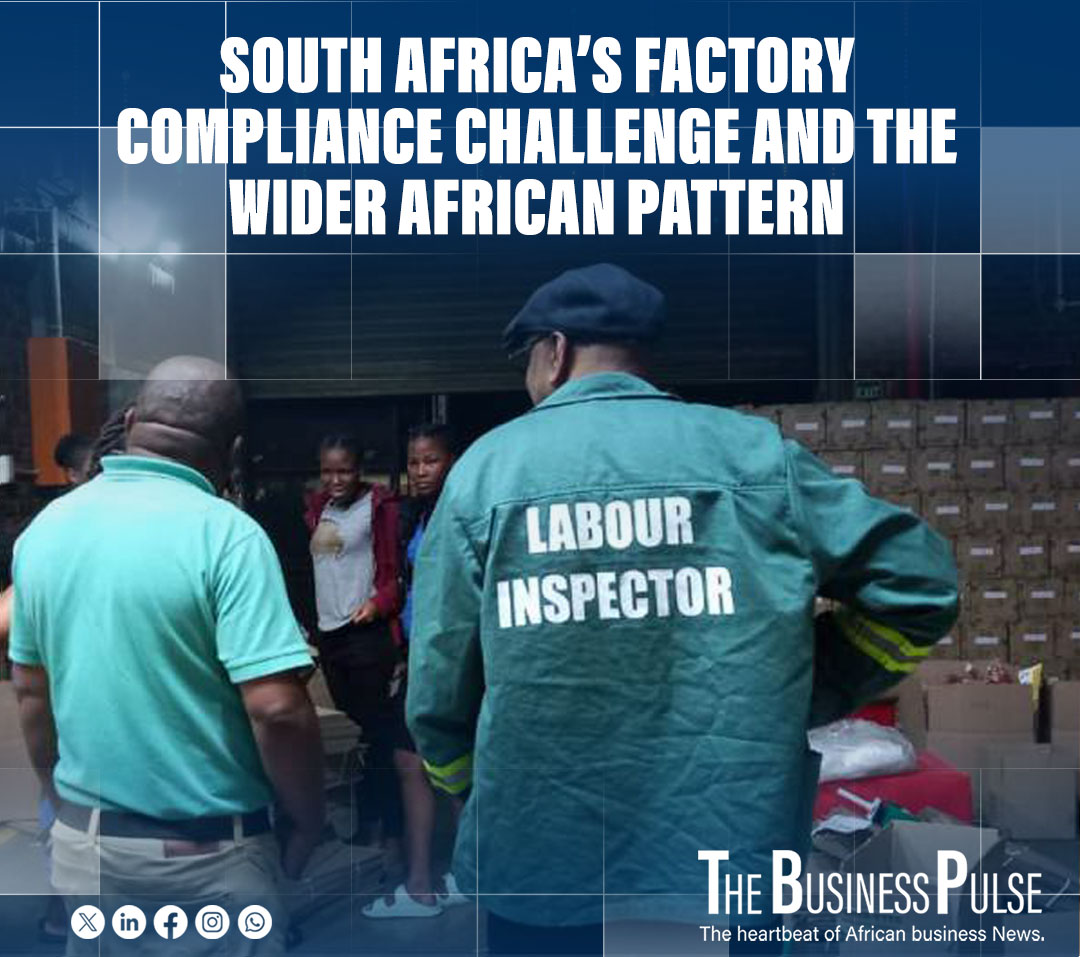
South Africa’s Factory Compliance Challenge and the Wider African Pattern
Recent arrests at a textile factory in Newcastle Industrial Park have drawn national attention to weaknesses in South Africa factory compliance. Authorities detained Chinese nationals accused of running a business on holiday visas, which do not permit employment. The factory, operating since 2018, was found during a multi-agency inspection to lack proper permits. Further allegations raised by Members of Parliament included undocumented workers, unsafe conditions, possible child labour, and extremely low wages. These claims remain under investigation, but the incident has reignited debate about how effectively industrial regulation is enforced.
This case is not an isolated event. It points to deeper structural problems within South Africa factory compliance, especially in struggling industrial towns where economic decline has weakened oversight and created space for informal operations.
Newcastle once had a strong textile sector that employed thousands. Over time, factory closures and reduced investment left the town vulnerable. Small-scale manufacturing operations emerged to fill the gap, some properly registered and others operating in grey zones. A 2022 survey found that only about 8 percent of factories in the area met labour and safety standards. That statistic alone explains why public anger is rising.
Join our WhatsApp Group
Why South Africa Factory Compliance Breaks Down
Several forces contribute to weak South Africa factory compliance.
Economic pressure is one of the biggest drivers. Factory owners face rising electricity costs, unstable supply chains, and shrinking profit margins. To stay afloat, some cut labour costs, avoid registration, or ignore safety rules. Workers accept these conditions because jobs are scarce.
Enforcement capacity is another challenge. Labour inspectors and immigration officers are often understaffed. One industrial zone may contain dozens of workshops operating behind closed doors. Without routine inspections, illegal practices can persist for years.
Visa misuse adds another layer. Cases involving Chinese nationals factories allegedly operated on tourist visas show how immigration loopholes are exploited. Business visas and work permits take longer to process and cost more. This creates incentives to bypass formal systems.
ALSO READ: Why are critical raw materials essential and so precious for industrial survival?
A Pattern Seen Across Africa
The Newcastle incident is part of a wider continental trend.
In Kenya, factories in Nairobi’s industrial zones have been fined for employing undocumented workers and paying wages below the legal threshold. In Nigeria, informal garment factories have been linked to fire hazards and unregulated foreign management. In Ethiopia, industrial expansion has outpaced inspection capacity, leading to concerns about long hours and workplace injuries.
These examples show that weak factory regulation is not unique to South Africa. But South Africa factory compliance is under particular strain because of high unemployment and strong political pressure around labour rights.
Political and Social Dimensions
The Newcastle case gained momentum after it became political. An MP publicly accused authorities of delayed enforcement. That public exposure led to arrests and inspections.
This demonstrates that South Africa factory compliance is not just administrative. It is deeply political. When communities believe laws are applied selectively, trust in institutions declines. When foreign-owned factories appear to avoid scrutiny, social tension increases.
At the same time, government faces a dilemma. Closing factories protects workers but increases unemployment. Leaving them open sustains jobs but allows exploitation. This tension sits at the centre of South Africa factory compliance debates.
What Must Change
If similar incidents are to be avoided, South Africa factory compliance must move from reactive enforcement to systematic control.
1. Routine inspections
Factories should be inspected on a fixed schedule rather than only after complaints. Digital registers of licensed factories would allow inspectors to track compliance history.
2. Immigration and labour coordination
Work permits, business licences, and tax registration should be checked together. A shared system between departments would reduce visa abuse linked to Chinese nationals factories and others.
3. Incentives for legal operation
Factories that comply with labour and safety laws could receive tax relief or access to development finance. Compliance should be rewarded, not just punished.
4. Worker reporting systems
Anonymous reporting platforms would allow workers to flag abuse without fear of losing jobs. Many violations persist because employees are afraid to speak.
5. Community monitoring
Local councils and industrial park managers should work with worker groups to observe factory practices. Community oversight can detect problems early.
Each of these reforms strengthens South Africa factory compliance without relying on emergency raids.
Investment and Regulation
There is a risk that public debate shifts toward nationality instead of legality. The issue is not whether factory owners are foreign, but whether they follow the law. Focusing only on Chinese nationals factories risks oversimplifying a structural problem.
South Africa needs investment in manufacturing to create jobs. But investment without regulation undermines fair competition. Businesses that comply with labour laws face higher costs than those that do not. That imbalance weakens the entire sector.
Effective South Africa factory compliance allows foreign and local investors to compete under the same rules. Predictable enforcement creates certainty and reduces corruption risks.
A Development Challenge
Manufacturing is critical for African development. It creates jobs and reduces dependence on raw material exports. But industrial growth without standards produces unsafe workplaces and wage suppression.
The Newcastle case shows how fragile the balance is. Weak oversight allows exploitation. Heavy-handed shutdowns worsen unemployment. Sustainable development requires institutions capable of handling both growth and regulation.
That is why South Africa factory compliance matters beyond one factory. It speaks to the credibility of the industrial system itself.
Conclusion
The Newcastle factory arrests exposed long-standing gaps in enforcement. Allegations of visa misuse, unsafe conditions, and underpayment show how weak oversight enables abuse. Similar patterns exist across Africa, but South Africa’s economic pressures make the issue particularly sensitive.
Strengthening South Africa factory compliance requires investment in inspection systems, coordination between departments, worker protection, and legal incentives for businesses. Framing the problem around legality rather than nationality is essential.
Whether factories are run by locals or by Chinese nationals factories, the standard must be the same: lawful operation, safe workplaces, and fair wages. Without reform, enforcement will remain reactive, scandals will repeat, and trust will continue to erode. With reform, industrial growth can coexist with worker protection and social stability.
Leave a Reply