
The Ease of Doing Business Index in Africa
For years, the global investment community has looked at the African continent with a mix of hungry opportunism and cautious trepidation. As we move through 2026, the conversation has shifted. We are no longer talking about Africa as a monolith. Instead, savvy observers are using the ease of doing business index in Africa to categorize nations into distinct tiers of reform. While some countries have sprinted toward digital-first economies, others remain stuck in the mud of 20th-century bureaucracy.
Understanding the ease of doing business index in Africa is not just an academic exercise; it is a survival guide for investors and a roadmap for local entrepreneurs. By “pigeon-holing” these economies into specific groups, we can identify exactly where the “light at the end of the tunnel” is shining and where the tunnel is still being dug.
Join our WhatsApp Group
Pigeon-Holing the Continent: The Three Tiers of Reform
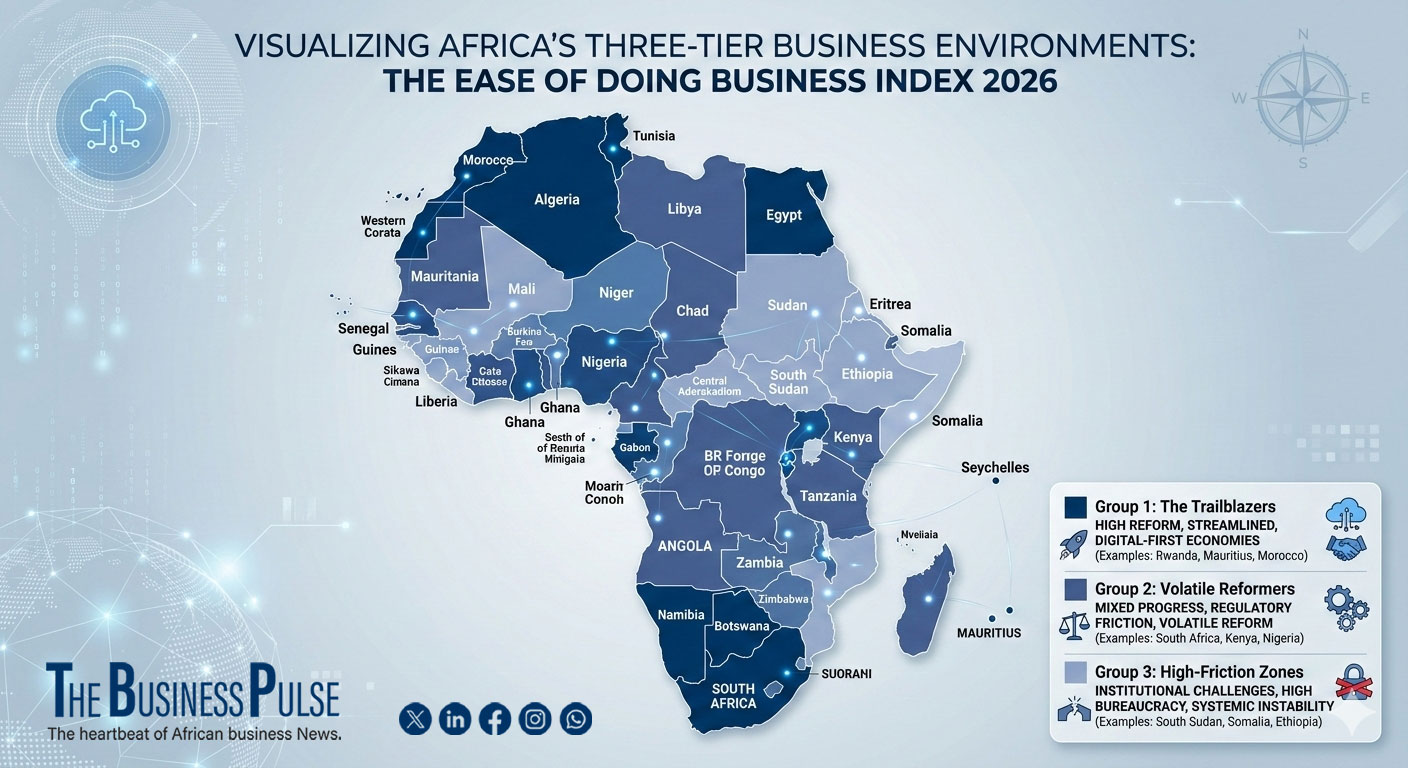
If we step back and look at the data, the 54 nations of the continent fall into three broad groups based on their performance within the ease of doing business index in Africa.
Group 1: The Trailblazers (The “Estonias” of Africa)
Countries like Mauritius, Rwanda, Morocco, and Seychelles have consistently dominated the top spots. These nations realized early on that capital is a “coward” it goes where it is welcomed and stays where it is well-treated.
- What they did right: They moved the entire business lifecycle online. In Rwanda, for example, you can register a business in under 24 hours. They have streamlined property registration and made the enforcement of contracts predictable.
- The Result: High levels of Foreign Direct Investment (FDI) relative to their GDP and a flourishing service sector.
Group 2: The Volatile Reformers (The Middle Ground)
This group includes the “Big Three” South Africa, Kenya, and Nigeria alongside rising stars like Ghana and Senegal. Their position on the ease of doing business index in Africa is often a tug-of-war between world-class innovation and crumbling infrastructure.
- The Struggle: You might find a high-tech fintech hub in Lagos or Nairobi, but the physical goods produced by those businesses might sit at a port for three weeks due to customs inefficiency.
- The Outlook: These are the high-reward, high-headache zones. They are making progress, but the “red tape” is thick and often politically motivated.
Group 3: The High-Friction Zones
In the bottom tier, we find countries like South Sudan, Eritrea, and Somalia, alongside larger nations struggling with internal conflict or extreme currency volatility, such as Ethiopia (despite recent liberalizations).
- The Crisis: Here, the ease of doing business index in Africa reflects a total lack of basic institutional infrastructure. Getting electricity is a miracle; getting a construction permit is a multi-year saga of bribes and lost paperwork.
What’s Going Wrong? Identifying the Friction Points
The primary reason many countries fail to climb the ease of doing business index in Africa is a lack of “Regulatory Humility.” Many governments still believe they should control every facet of the market rather than acting as a facilitator.
1. Infrastructure Deficits:
You cannot have an “easy” business environment if the lights go out four times a day. Energy poverty remains the single biggest hurdle to manufacturing.
2. Fragmented Markets:
Until recently, a business in Zambia found it harder to trade with a business in neighboring Malawi than with a company in Europe. The ease of doing business index in Africa has historically been suppressed by borders that act as barriers rather than bridges.
3. Judicial Uncertainty:
If a contract is breached, how long does it take to get a judgment? In Tier 3 countries, it can take 1,000 days. Investors don’t mind risk, but they hate uncertainty.
The Locus of Control: What We Can and Cannot Change
To understand if there is light at the end of the tunnel, we must distinguish between what is within a nation’s control and what is dictated by the global “weather.”
Within Our Control (The “Low-Hanging Fruit”)
- Digitization: Moving tax filings and permit applications online removes the “human interface” where corruption often occurs.
- Policy Consistency: Governments can choose not to change tax laws every six months.
- The AfCFTA: The African Continental Free Trade Area is a massive internal lever. By 2026, it has already begun to harmonize trade rules, directly improving the ease of doing business index in Africa.
Outside Our Control (The “Global Weather”)
- Global Commodity Prices: Countries dependent on oil or copper are at the mercy of global markets. No amount of local reform can stop a global price crash.
- Global Interest Rates: When the US Federal Reserve raises rates, capital flows out of emerging markets, making it harder for local African businesses to get credit.
The Stakeholder Impact: Investors, Locals, and Citizens
The ease of doing business index in Africa is often dismissed as a “rich man’s metric,” but its impact trickles down to the most vulnerable citizens.
- For Investors: A low ranking acts as a “risk premium.” Investors demand higher returns to compensate for the hassle, which makes projects more expensive.
- For Local Businesses: They suffer the most. A multinational can hire a team of lawyers to navigate 50 permits; a local SME cannot. Burdensome regulations effectively kill local entrepreneurship before it can scale.
- For Ordinary Citizens: High friction means fewer jobs and higher prices. If it costs a truck driver $500 in bribes to cross a border, the citizen pays $1 more for a bag of flour. Improved rankings on the ease of doing business index in Africa are directly correlated with poverty reduction.
African vs. European Economies: Mirror or Mirage?
When we compare the ease of doing business index in Africa with European economies like Denmark, Germany, or Estonia, we see a stark difference in “Institutional Memory.”
What did Europe do right?
- Rule of Law: In Europe, the law is usually above the politician. In many African Tier 3 states, the politician is the law.
- Infrastructure Maturity: Europe hasn’t had to build a power grid from scratch in 70 years; they are just maintaining it. Africa is trying to build the grid and reform the law simultaneously.
- The Digital Leapfrog: This is where Africa is actually beating parts of Europe. Estonia is the gold standard of digital government, but countries like Rwanda are closer to the Estonian model than “old world” bureaucracies like Italy or Greece.
Are Africans on the right path? Yes. It is a matter of “institutional aging.” Europe had centuries to fail and refine their systems. Africa is attempting to compress that 300-year journey into 30 years. The trajectory of the ease of doing business index in Africa shows that countries are not just copying Europe; they are leapfrogging them using mobile technology and decentralized finance.
ALSO READ: MTN Full Control of IHS Towers in $2.2 Billion Deal Reshapes Telecom Infrastructure Landscape
Is There Light at the End of the Tunnel?
As we look at the data for 2026, there is significant cause for optimism. The “pigeon-holes” are breaking. We see Tier 2 countries like Kenya and Ghana aggressively moving into Tier 1 territory through “Regulatory Sandboxes” for tech companies.
The ease of doing business index in Africa is being lifted by a new generation of leaders who view the private sector as an ally rather than a cow to be milked. The “light” is coming from the AfCFTA and the mass digitization of port authorities and land registries.
“The goal isn’t just to rank higher on a global list; the goal is to create an environment where a young girl in Bulawayo or Lagos can start a company as easily as a teenager in Berlin.”
Conclusion
The ease of doing business index in Africa remains a mixed bag, but the trend is undeniably toward transparency. While Group 3 laggards continue to struggle with systemic instability, the Trailblazers of Group 1 have proven that “African-led reform” is not a myth it is a reality.
The continent is not just waiting for time to pass so it can catch up to Europe. It is actively rewriting the rules of engagement. For the investor, the local SME, and the ordinary citizen, a better ranking on the ease of doing business index in Africa represents a future where opportunity is not a privilege for the connected few, but a right for the industrious many.
The tunnel is long, but for the first time in decades, the exit is clearly in sight.

Head of Business Development, Alula Animation. With 10 years in advertising and sustained involvement in startups and entrepreneurship since graduating from business school and the School of Diplomacy and International Relations, Beloved researches and writes practical business analysis and verified job-market insights for The Business Pulse Africa.
Leave a Reply