
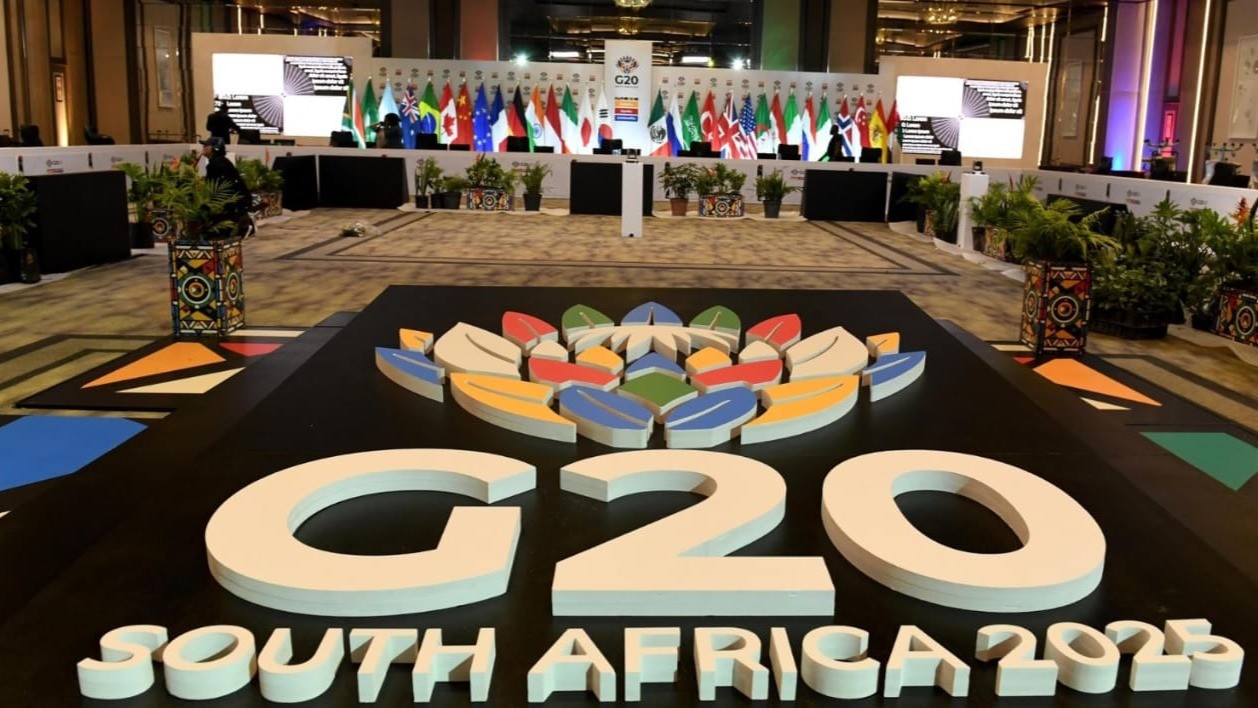
President Ramaphosa met EU leaders in Sandton ahead of the G20 Leaders’ Summit. The trilateral talks with the President of the European Council António Costa and the President of the European Commission Ursula von der Leyen focused on stronger economic and political ties. The meeting reinforced South Africa’s role on the global stage. It also advanced concrete steps to boost trade, investment and green industry.
The leaders reviewed progress since the March 2025 South Africa–EU Summit in Cape Town. They noted closer cooperation in areas that matter to businesses and workers. They reaffirmed support for multilateralism. They also stressed the importance of the United Nations Charter in resolving international crises.
Join our WhatsApp Group
A priority outcome was the Clean Trade and Investment Partnership. This partnership aims to expand trade while supporting decarbonisation. It will target clean value chains and regulatory cooperation. The aim is to create trade opportunities that align with climate goals. For South Africa this means more opportunities for green investment and cleaner industrial growth.
The leaders also signed a Memorandum of Understanding on Sustainable Minerals and Metals Value Chains. The MoU seeks to promote local value addition. It aims to drive beneficiation near the source of extraction. That approach can create higher value jobs in mining regions. It can also strengthen industrial integration between South Africa and the EU.
Energy cooperation was another key topic. South Africa and the EU launched an energy dialogue in September 2025. The dialogue will be elevated to the ministerial level next year. It will focus on transmission infrastructure and clean energy technologies. It will also explore the future export of sustainable aviation fuel to Europe. The dialogue creates a platform for policy alignment and investor certainty.
Also Read ~ Springbok Powered Braai Republic Ignites South Africa’s Fast Food Scene
Market access featured in the talks. The leaders agreed to speed up discussions on agriculture and animal products. South Africa committed to advancing applications for EU market access, including poultry. The EU signalled willingness to consider listing South Africa for shelf stable composite products. Such access would support food exporters and boost trade volumes.
A practical step in support of local manufacturing is the temporary derogation on battery cumulation under the SADC Economic Partnership Agreement. The derogation allows South African and EU battery inputs to be cumulated for vehicle exports. This can help establish battery manufacturing and help South Africa join regional electric vehicle supply chains.
The EU announced project support under the Team Europe Global Gateway package. The projects include blended finance and technical assistance for green hydrogen and battery value chains. The European Investment Bank will provide a loan to support Transnet’s decarbonisation. Other initiatives will back vaccine manufacturing capacity and human development projects. These investments can mobilise private finance and spur local industrial activity.
Security cooperation was on the agenda as well. The leaders discussed counter terrorism, maritime security and cybersecurity. They agreed to enhance intelligence sharing and collaboration on mediation efforts. These measures aim to protect trade routes and foster a safer environment for investment.
President Ramaphosa framed these engagements in the context of South Africa’s G20 Presidency. He emphasised the need for renewed global financing for sustainable development. He also called for a just and lasting peace in conflict zones such as Ukraine and Sudan. The G20 platform gives South Africa leverage to push for reforms to global financing and trade rules that reflect African priorities.
The outcomes matter for the economy. New trade deals and project finance can support industrialisation. They can also create jobs and boost exports. For investors, clearer regulatory cooperation reduces uncertainty. For local firms, greater market access opens new customers and partnerships. For communities, value addition in mining and energy sectors can deliver local benefits.
There are implementation challenges. Success will depend on regulatory clarity and consistent policy. South Africa must ensure governance and environmental standards are robust. Both sides will need to monitor progress and deliver on timelines. Strong public private partnerships will be important to translate agreements into projects on the ground.
In sum, the Sandton meeting reinforced a practical and positive EU-South Africa agenda. It combined strategic cooperation on climate, trade, industry and security. It also positioned South Africa to drive key issues during the G20. The agreements signal to markets that South Africa and the EU are aligning on long term partnership goals. If executed well, these steps can accelerate investment, support industrial growth and deepen economic ties between South Africa and the European Union.

Head of Business Development, Alula Animation. With 10 years in advertising and sustained involvement in startups and entrepreneurship since graduating from business school and the School of Diplomacy and International Relations, Beloved researches and writes practical business analysis and verified job-market insights for The Business Pulse Africa.
Leave a Reply