
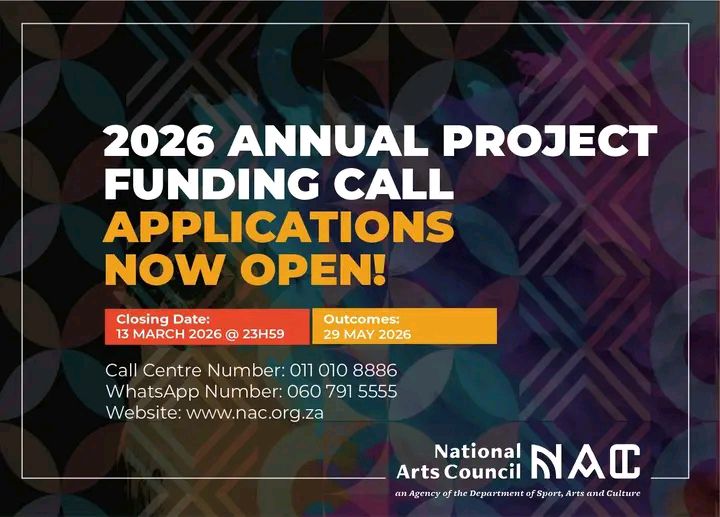
Nac Annual Project Funding 2026 – Arts Project Grants in South Africa
The Nac annual project funding call for the 2026–2027 financial year invites individual arts practitioners, registered arts organisations, and community arts centres in South Africa to submit proposals for project support. Administered by the National Arts Council (NAC) of South Africa, this competitive funding opportunity aims to stimulate artistic innovation, strengthen community impact, and support culturally grounded creative initiatives that contribute to national development priorities. Arts practitioners working across disciplines such as craft, dance, literature, music, theatre, visual arts, and multidisciplinary arts are encouraged to apply under the Nac annual project funding programme.
The Nac annual project funding initiative is structured to promote fair access to financial support across the creative sector. Projects that demonstrate innovation, social relevance, and strong community engagement are prioritised. The NAC recognises that the arts play an important role in social cohesion, cultural preservation, economic participation, and creative expression. For this reason, the Nac annual project funding call focuses on proposals that address broader social needs while strengthening South Africa’s creative industries.
Join our WhatsApp Group
Objectives of Nac Annual Project Funding
The main objectives of Nac annual project funding are to:
- Support impactful arts projects that demonstrate artistic quality and originality.
- Increase access to arts and culture in diverse communities.
- Promote indigenous and marginalised art forms.
- Build capacity and professional development for artists and arts organisations.
- Encourage new works and digital artistic production.
- Use creative practice to address social challenges and promote unity.
Applicants are encouraged to design projects that clearly contribute to at least two of these objectives to improve their chances of approval under the Nac annual project funding programme.
Who Can Apply
The Nac annual project funding opportunity is open to:
- Individual artists and cultural practitioners.
- Registered arts organisations and cultural institutions.
- Community-based arts centres.
Applicants must demonstrate the ability to implement their proposed project and clearly explain the expected outcomes and impact. Only one application per applicant or organisation is allowed per funding cycle.
ALSO READ: AIDS Foundation of South Africa (AFSA) Seeks a Business Development Manager to Grow Its National HIV Response
Priority Disciplines and Artistic Fields
The Nac annual project funding call supports projects in the following areas:
- Craft and visual arts
- Dance and movement arts
- Literature and storytelling
- Music and performance
- Theatre and musical theatre
- Multidisciplinary arts combining different forms
Projects that promote indigenous knowledge systems and local cultural traditions are especially encouraged. Proposals that include skills development, training in arts entrepreneurship, or intellectual property awareness are also viewed positively within the Nac annual project funding framework.
Critical Focus Areas
To qualify for Nac annual project funding, applications must show alignment with at least two of the following focus areas:
- Social Cohesion and Nation Building – Projects that unite communities and promote inclusion.
- Marginalised and Indigenous Arts – Initiatives supporting rural, traditional, or underrepresented art forms.
- Addressing Social Challenges – Artistic responses to issues such as gender-based violence, crime, or inequality.
- Support for Vulnerable Groups – Projects benefiting women, youth, people with disabilities, and disadvantaged communities.
- New Works and Digital Innovation – Creative work using digital platforms or experimental methods.
- Capacity Building and Arts Entrepreneurship – Training initiatives that strengthen professional skills and sustainability.
Applicants should clearly explain how their project contributes to these focus areas when applying for Nac annual project funding.
Funding Structure and Use of Funds
Funding amounts depend on project scale and scope, as defined by NAC guidelines. Budgets must be realistic and linked directly to project activities. Allowable costs typically include:
- Artist fees and facilitators
- Production and materials
- Venue and technical costs
- Travel related to project delivery
- Marketing and audience development
- Administration directly related to the project
Successful applicants under Nac annual project funding are required to submit progress and final reports showing how funds were used and what outcomes were achieved.
Application Process
The Nac annual project funding application process includes:
- Completing the online application form.
- Submitting a project proposal describing objectives, activities, and expected impact.
- Providing a detailed budget and work plan.
- Uploading supporting documents such as identification and registration certificates where applicable.
- Awaiting assessment by expert panels appointed by the NAC.
Applications are reviewed according to artistic merit, relevance to focus areas, feasibility, and potential community benefit.
Assessment Criteria
Applications submitted under Nac annual project funding are assessed using the following criteria:
- Quality and originality of the proposed project.
- Alignment with NAC focus areas and priorities.
- Practicality of the implementation plan.
- Financial accountability and realistic budgeting.
- Evidence of community or audience impact.
- Capacity of the applicant to deliver the project successfully.
Clear project descriptions and structured budgets improve the chances of approval under the Nac annual project funding scheme.
Importance of Nac Annual Project Funding
The Nac annual project funding programme plays an essential role in supporting South Africa’s arts sector. By providing financial assistance, the programme enables artists to produce new work, reach wider audiences, and strengthen their professional practices. It also supports projects that promote cultural heritage, community participation, and social dialogue.
Many projects supported through Nac annual project funding contribute to job creation, skills transfer, and cultural tourism. These outcomes help position the arts as a meaningful contributor to national development.
Reporting and Accountability
Recipients of Nac annual project funding must submit:
- A progress report during project implementation.
- A final narrative report describing outcomes.
- A financial report showing how funds were spent.
- Supporting evidence such as photos, attendance records, or programme materials.
Failure to comply with reporting requirements may affect eligibility for future funding cycles.
Conclusion
The Nac annual project funding call offers South African artists and arts organisations a valuable opportunity to secure financial support for creative projects that are culturally relevant and socially meaningful. Whether focused on heritage preservation, digital creativity, community engagement, or new artistic production, this funding programme provides a pathway to turn creative ideas into practical initiatives.
Applicants are encouraged to prepare clear proposals, align projects with the NAC’s focus areas, and submit complete documentation. The Nac annual project funding programme remains a key instrument for strengthening South Africa’s cultural landscape and supporting the growth of the creative economy.
Disclaimer: The Business Pulse shares verified opportunities from trusted sources. We are not a recruiting agency and do not request any payment for applications.

Head of Business Development, Alula Animation. With 10 years in advertising and sustained involvement in startups and entrepreneurship since graduating from business school and the School of Diplomacy and International Relations, Beloved researches and writes practical business analysis and verified job-market insights for The Business Pulse Africa.
Leave a Reply