
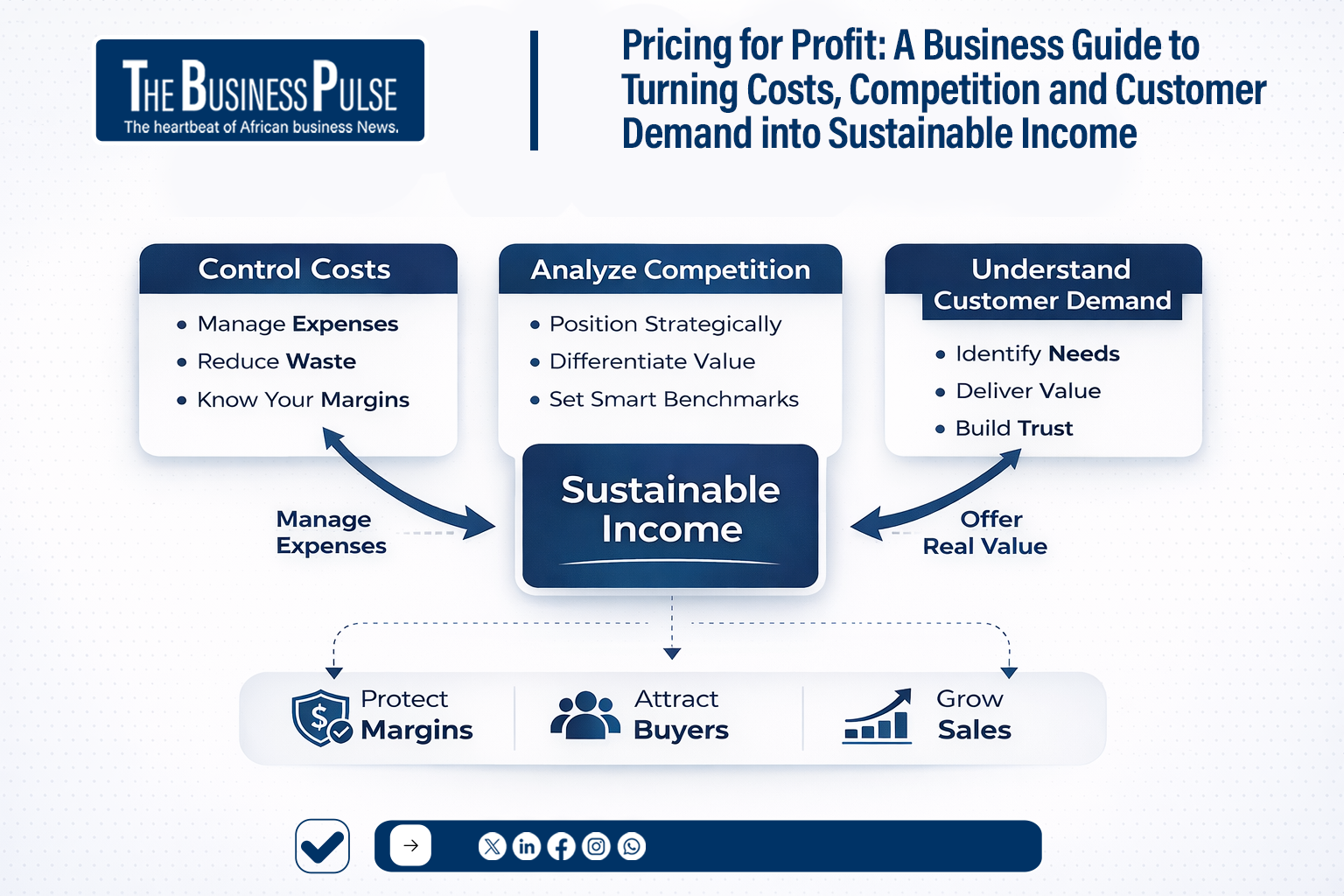
Pricing for Profit:
Pricing for profit is the single most powerful lever a business has to protect margins and fund growth. Setting the right price is a disciplined process that balances costs, customer perception, market positioning and strategic objectives. This article explains the factors that affect price decisions, how to set prices without sending customers to competitors, and how to design pricing for profit that encourages purchase and repeat business.
Why pricing matters
Pricing for profit changes how revenue converts to operating margin. A small change in price can produce a large change in net income. Price also signals quality and positioning in the market. Undercutting too aggressively trains customers to expect discounts, while asking too much reduces conversion. Pricing for profit requires clarity on total cost, customer value, channel economics and competitive behaviour.
Know your full cost
You cannot practise pricing for profit without knowing full unit cost. This goes beyond direct materials. It includes distribution, packaging, customer acquisition cost, returns and warranty, depreciation, financing cost and an appropriate allocation of overhead. When you know your total cost per unit, you can set a floor price and target a realistic margin that covers growth investment and risk.
Join our WhatsApp Group
Segment customers by willingness to pay
Pricing for profit is easier when you recognise different customer segments. Retail buyers, wholesale purchasers and enterprise clients value different things and respond to price in different ways. Conduct simple surveys, pilot offers or historical analysis to map willingness to pay. Use that insight to create channel or segment-specific price lists rather than a single price that leaves money on the table.
Map customer value points
To succeed with pricing for profit, map the customer journey and identify moments when your product delivers real value. Attach premium elements to moments that matter: guaranteed delivery time, local support, training, performance guarantees or money back options. Customers will pay for certainty and convenience when the benefits are communicated in business terms, not marketing speak.
Measure price sensitivity with experiments
Pricing for profit depends on understanding demand elasticity. Rather than changing price across all markets at once, test price changes in controlled segments or geographies. Use experiments to measure conversion, average order value and churn. Treat pricing as a repeatable experiment with hypotheses, timelines and metrics so you learn quickly and limit downside.
Design tiered offerings to capture different buyers
Tiered offers and add-on services support pricing for profit. Offer a basic version at a competitive entry price, a standard version with stronger support, and a premium version that includes training or customisation. Consider recurring revenue models or service contracts which are easier to scale and protect margin. Ensure the premium tiers are differentiated on tangible outcomes so customers can justify the spend.
Use anchoring and framing ethically
Anchoring and framing are behaviourally driven tools that influence purchase decisions. Present a premium option first or show the most popular package as the default. Pricing for profit uses anchoring to steer customers to higher value options without misleading them. Keep communications transparent so customers understand the true value and don’t feel manipulated.
Manage discounts as a strategic lever
Frequent discounting erodes pricing power. When you use discounts, do so strategically: customer acquisition promotions, limited-time offers to clear stock or loyalty rewards for repeat buyers. Pricing for profit treats discounts as part of a broader acquisition and retention playbook. Always measure acquisition cost versus lifetime value before running widespread discounts.
Communicate price and value with clarity
How you present price affects buyer behaviour. Pricing for profit relies on transparent packaging and clear lists of included services. If the price includes guarantees or post-sale support, state that prominently to remove buyer doubt. Simple, clear pricing reduces friction and increases the chance that a customer will press purchase.
Offer payment flexibility, not permanent price cuts
Payment plans, subscriptions and financing increase affordability while preserving headline price. Pricing for profit can be maintained by offering payment flexibility that smooths the cash barrier for customers. Partnering with reputable financing providers can extend reach without placing credit risk on your balance sheet.
Track unit economics by channel and customer
Not all customers are equally profitable. Track gross margin, contribution margin and total cost to serve by product, channel and customer type. Pricing for profit becomes a targeted activity when you know which segments accept higher prices and which need lower-touch service. Use this data to protect high-margin accounts and automate low-margin workflows.
Avoid feature bloat that reduces margin
Adding features without price justification dilutes profit. Customers often do not value every incremental function. Make hard product decisions: move non-core features to premium tiers or offer them as optional paid add-ons. Pricing for profit requires focus on what customers will pay for, not what you can build.
Protect margins with contracts and clauses
Contracts are powerful tools for preserving price. Include annual review clauses, indexation to inflation, defined change orders and penalties for late payment. Multi-year agreements with clear escalation formulas secure margin and reduce selling costs over time. Pricing for profit includes the legal architecture to guard value.
Build governance and approval processes
Pricing must be governed. Define approval levels for discounts, maintain a central price list, and require business justification for exceptions. Use straightforward workflows that prevent frontline staff from giving away margin casually. Pricing for profit is easier to sustain when there is consistent policy and accountability.
Train sales to sell outcomes instead of discounts
Sales teams often default to discounting. Train them to sell outcomes, not features. Equip sales with ROI calculators, case studies and objection handling scripts that justify price in business terms. Pricing for profit benefits from incentive plans that reward margin, retention and lifetime value rather than only volume.
Use psychology carefully to increase perceived value
Small details matter. Price endings, the order of options and perceived scarcity influence buying. Pricing for profit uses behavioural design to increase perceived value while staying honest. Avoid manipulative tactics that damage trust over time and focus on tested methods that align price with customer benefit.
Implement pricing experiments and measure impact
Run A/B tests, limited launches and channel-specific trials. Pricing decisions should be validated with data on conversion, average order value and churn. Pricing for profit is a continuous learning process; document outcomes and scale successful experiments.
Case example: raise price without losing customers
A regional manufacturer increased its base price by five percent and simultaneously introduced a premium faster-delivery tier. Management framed the change as an investment in tighter quality control and faster fulfilment. The company emphasised the added guarantees and tracked metrics showing higher average order value. The result was improved margins and similar churn rates. This is the kind of practical move that demonstrates pricing for profit in action.
Tools, automation and governance at scale
As your business grows, integrate pricing tools into your CRM and finance systems. Automate price lists, approval workflows and channel-specific pricing. Pricing for profit scales when supported by reliable systems that reduce manual errors and speed approvals.
ALSO READ: The Embedded Finance in Africa: A Revolution As Leading Startups Are Abandoning Agency Banking
Quick implementation checklist
Turn your pricing process into a routine. Document total unit cost and cost-to-serve. Identify most profitable segments and set channel-specific price lists. Run at least one price experiment per quarter. Formalise discount approvals and set measurable targets for margin and customer lifetime value. Use a dashboard for leadership review and assign a pricing owner.
Common pricing mistakes to avoid
Do not let competition alone dictate price. Avoid offering critical services for free. Do not use cost-plus pricing exclusively without testing value-based options. Avoid too many SKUs that confuse buyers and staff. Do not allow ad hoc discounts without proper governance.
How pricing improves business resilience
Good price discipline builds a margin cushion that protects the business during downturns. It enables investment in quality, customer service and product development. Pricing aligned with value reduces churn because buyers who pay more expect better service. When price reflects real value, you compete on outcomes rather than on cost.
Final steps and leadership priorities
Make pricing a leadership priority. Appoint a pricing owner to coordinate finance, product and sales. Use simple tools to track the impact of price on cash flow and profitability. Iterate from small experiments and learn from market feedback. With consistent attention, price becomes a sustainable competitive advantage rather than an afterthought.
Conclusion
Pricing for profit is a strategic capability that combines cost clarity, customer value mapping, testing and governance. Master these elements and your business protects margin, funds growth and attracts customers who pay for real value. Treat price as a decision that shapes the future of the business and not merely a tactical response to competitors.

Head of Business Development, Alula Animation. With 10 years in advertising and sustained involvement in startups and entrepreneurship since graduating from business school and the School of Diplomacy and International Relations, Beloved researches and writes practical business analysis and verified job-market insights for The Business Pulse Africa.
Leave a Reply