
AI in African E-commerce:
Artificial intelligence is transforming global online retail. In developed markets, AI powers robotic warehouses, real-time fraud detection, and highly personalized shopping experiences. In Africa, however, the role of artificial intelligence looks different. Infrastructure gaps, unreliable logistics, and fragmented payment systems shape how digital commerce evolves. Yet AI in African e-commerce is no longer theoretical. It is becoming a practical tool for solving local business problems.
Rather than chasing futuristic automation, African online businesses are using artificial intelligence to reduce losses, build trust with customers, and operate more efficiently in difficult conditions. This makes AI in African e-commerce less about technological prestige and more about economic survival and adaptation.
Join our WhatsApp Group
The Context of African Digital Commerce
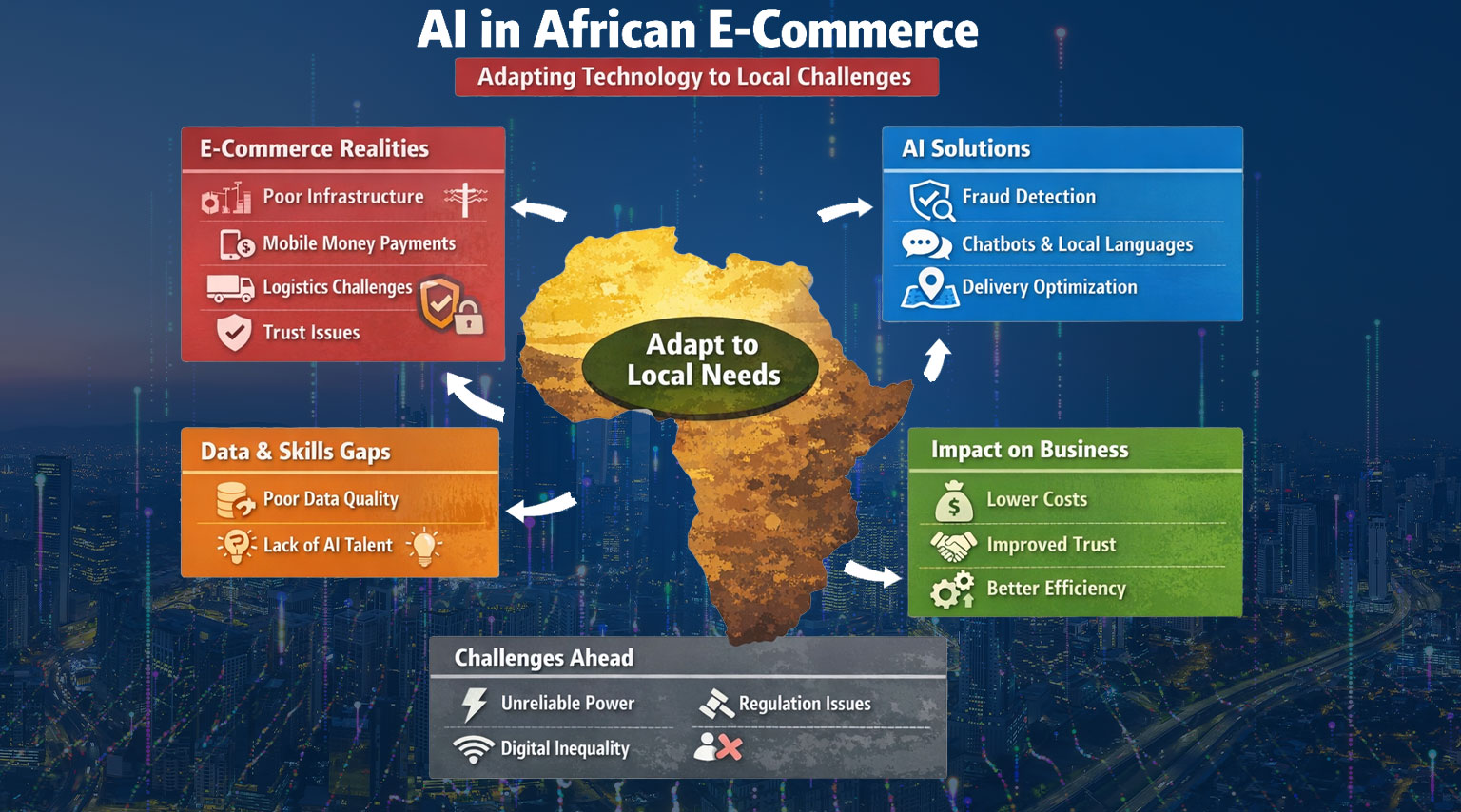
African e-commerce does not operate on the same foundations as platforms in Europe, China, or the United States. Many consumers rely on mobile phones instead of laptops, internet access is inconsistent, and national addressing systems are often weak or incomplete. Payments are dominated by mobile money rather than bank cards, and delivery networks are expensive to run and difficult to scale.
These realities mean that AI in African e-commerce is not focused on warehouse robots or same-day drone delivery. Instead, it is applied to problems such as predicting failed deliveries, identifying fraudulent buyers and sellers, and helping businesses understand unpredictable customer demand. Artificial intelligence becomes a support system for fragile operations rather than a luxury layer on top of efficient ones.
Why Artificial Intelligence Matters for African Online Businesses
Most African e-commerce businesses operate on thin margins. Manual systems are expensive to maintain, and scaling customer service, fraud control, and marketing teams quickly becomes unaffordable. AI tools allow companies to automate repetitive tasks while still improving decision-making.
Customer service chatbots, for example, allow platforms to respond to thousands of users without expanding call centers. Fraud detection algorithms help prevent losses in markets where online scams remain common. Recommendation systems help small retailers show relevant products to customers who are browsing on slow connections and low-cost devices.
In this sense, AI in African e-commerce functions as a cost-control mechanism. It allows businesses to grow without proportionally increasing staff numbers, which is critical in economies where labor costs are rising but revenues remain volatile.
ALSO READ: SME Failure Prevention: A Practical Guide for African Small Businesses
Customer Service and Language Challenges
Africa’s linguistic diversity presents a major challenge for online commerce. Many users prefer to communicate in local languages rather than English or French. Traditional customer support systems struggle to handle this complexity.
Artificial intelligence offers partial solutions. AI-driven chat systems can be trained to respond in multiple languages and operate continuously without fatigue. These systems can handle basic tasks such as order tracking, refund requests, and payment confirmation. This improves response time and customer satisfaction.
However, AI in African e-commerce also faces limitations in this area. Many African languages lack large digital datasets for training algorithms. Voice recognition systems struggle with accents and informal speech patterns. Trust remains an issue, as some customers prefer human interaction when money is involved. Despite these obstacles, automated support is gradually becoming an essential part of digital retail across the continent.
Building Trust in Online Transactions
Trust is one of the biggest barriers to the growth of e-commerce in Africa. Consumers fear counterfeit goods, lost deliveries, and fraudulent sellers. Artificial intelligence helps reduce these risks by monitoring behavior patterns and detecting anomalies.
Algorithms can flag suspicious accounts, identify unusual purchasing behavior, and monitor seller performance. Image recognition tools can compare product photos to known counterfeits. Transaction analysis can reveal coordinated fraud attempts. These tools reduce financial losses while reassuring customers that platforms are actively protecting them.
This means AI in African e-commerce is not simply about increasing sales. It plays a central role in building confidence in digital markets, which is essential for long-term adoption of online shopping.
Payments and Financial Inclusion
Africa’s payment environment is complex. Credit cards remain rare in many countries, while mobile money dominates everyday transactions. Artificial intelligence helps manage this complexity by predicting payment failures and identifying suspicious transfers.
AI systems can analyze transaction histories to assess risk for buy-now-pay-later services and digital credit offerings. This supports financial inclusion by allowing platforms to extend limited credit to users without formal banking records. In this way, AI in African e-commerce links retail activity with broader financial systems and credit access.
By reducing chargebacks and detecting irregular patterns, artificial intelligence also protects merchants from losses, which is critical in markets where profit margins are narrow and legal enforcement is slow.
ALSO READ: Mastering Social Media Marketing for Business: The Strategic Deep-Dive to Building Unshakable Brand Authority and Driving Growth
Logistics and Delivery in Difficult Terrain
Logistics remains the greatest challenge for African e-commerce. Informal settlements, poor road networks, and the absence of standardized addresses make last-mile delivery unpredictable and costly. Artificial intelligence improves logistics by learning from past failures and optimizing future routes.
AI systems analyze delivery data to predict which orders are most likely to fail, which neighborhoods experience delays, and which time windows work best. They can suggest route changes for drivers and adjust delivery promises to customers based on historical performance.
Without solving logistics problems, AI in African e-commerce cannot achieve meaningful impact. The value of artificial intelligence lies not in advanced automation but in incremental improvements that reduce fuel costs, minimize failed deliveries, and improve communication with customers.
Marketing and Demand Forecasting
African consumers are highly price-sensitive. Promotions and discounts strongly influence purchasing behavior. Artificial intelligence allows platforms to analyze customer patterns and predict demand more accurately.
By studying transaction histories, location data, and browsing behavior, AI systems can determine which products are likely to sell in specific regions and at specific times. This helps businesses avoid overstocking and stockouts. It also allows marketing teams to target promotions more precisely.
Here, AI in African e-commerce replaces guesswork with evidence-based planning. Instead of relying on intuition, businesses can use data-driven insights to manage inventory and promotions.
Infrastructure Constraints
Despite its potential, AI in African e-commerce faces major structural limits. Electricity supply remains unreliable in many countries. Mobile data is expensive, and cloud computing resources are often hosted outside the continent. Technical expertise is limited, and hardware costs remain high.
These constraints mean that artificial intelligence adoption is uneven. Large platforms benefit more than small businesses. Urban areas benefit more than rural ones. Most AI tools used in African e-commerce are imported and adapted rather than developed locally.
As a result, the benefits of artificial intelligence are distributed unequally, reflecting broader patterns of digital inequality.
ALSO READ: Why at times Owning the Distribution Channel Matters More Than Owning the Product?
Data Quality Problems
Artificial intelligence depends on data, but many African e-commerce businesses struggle with poor data quality. Incomplete customer records, false phone numbers, and inconsistent addresses weaken machine learning systems.
For AI in African e-commerce to work effectively, companies must first invest in basic data management. This includes verifying customer information, cleaning transaction records, and standardizing digital forms. Without this foundation, AI systems produce unreliable results and may even worsen decision-making.
Skills and Employment Effects
The adoption of artificial intelligence changes workforce needs. Routine tasks such as data entry and basic customer support are increasingly automated. At the same time, demand grows for data analysts, digital marketers, and cybersecurity specialists.
Many African economies lack training systems to meet this shift. Universities and vocational institutions are still adjusting to the requirements of data-driven commerce. For AI in African e-commerce to be sustainable, education systems must evolve alongside technology adoption.
Ethics and Regulation
Artificial intelligence raises questions about privacy, surveillance, and discrimination. African regulatory frameworks remain underdeveloped in this area. Most countries lack comprehensive AI governance laws, and data protection enforcement is weak.
This creates risks for consumers and uncertainty for businesses. Responsible use of AI in African e-commerce requires clear standards for data handling, algorithmic transparency, and consumer rights.
Adaptation Versus Imitation
Many failed African digital platforms attempted to copy Western or Chinese business models without adapting to local realities. Successful platforms instead use artificial intelligence to solve specific operational problems such as fraud, delivery failure, and payment risk.
This shows that AI in African e-commerce must be contextual. It must respond to infrastructure limits and consumer behavior rather than replicate foreign systems that assume stable power supply, high card usage, and advanced logistics networks.
Conclusion: Intelligence in Imperfect Markets
Artificial intelligence will not turn African e-commerce into a mirror image of Silicon Valley or Shenzhen. Its role is more modest but more important. It reduces losses, increases trust, and improves efficiency in fragile systems.
AI in African e-commerce succeeds when it lowers costs, strengthens logistics, improves payment reliability, and builds consumer confidence. It fails when it ignores infrastructure weaknesses or replaces business strategy with technology hype.
In Africa, artificial intelligence is not about futuristic automation. It is about adapting advanced tools to imperfect conditions. The future of AI in African e-commerce will be shaped not by algorithms alone but by infrastructure investment, skills development, and thoughtful regulation. It is ultimately a story of how developing economies reshape global technologies to fit their own realities.
Leave a Reply