
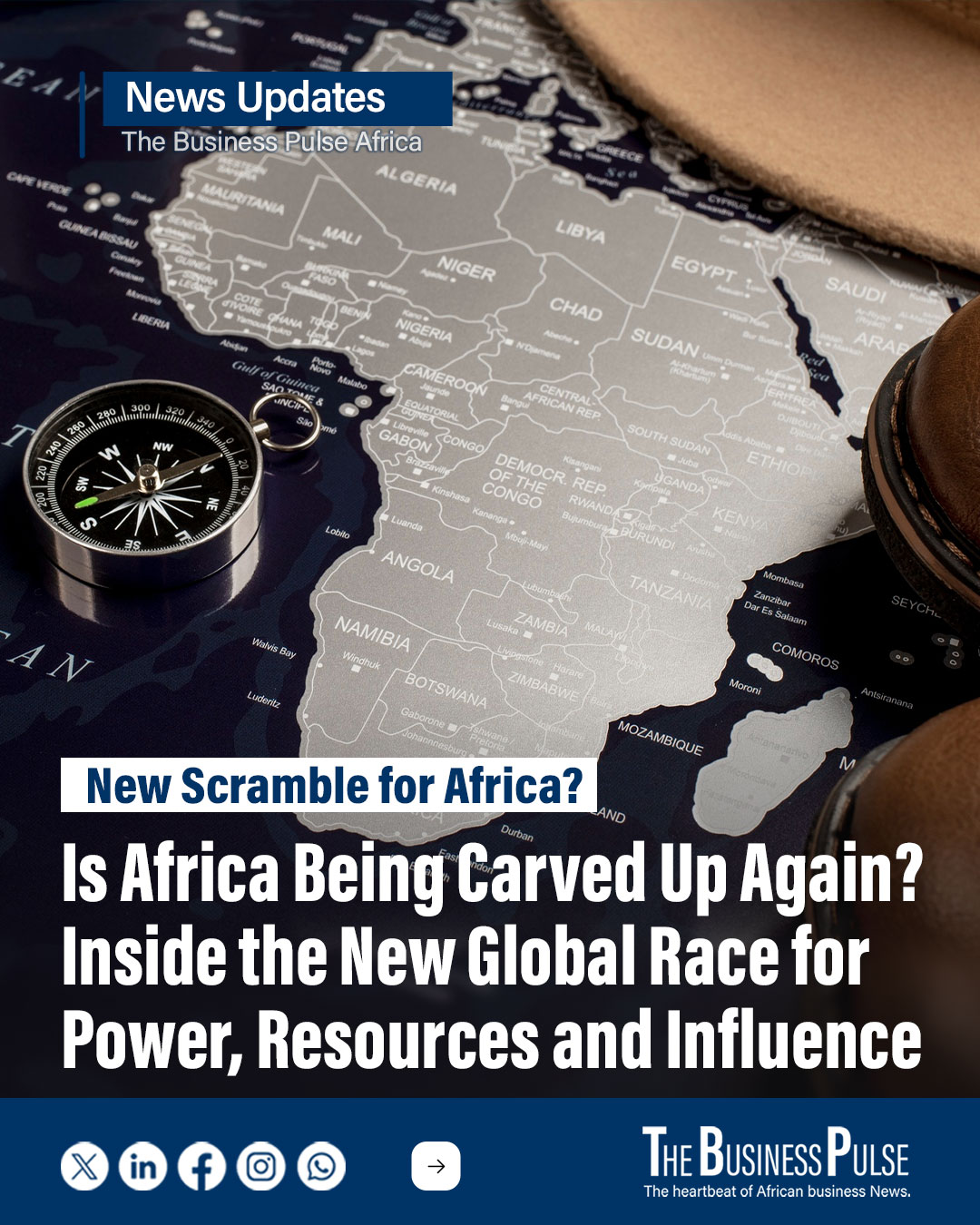
New Scramble for Africa: Power, Profit and the Battle for Influence
Africa is once again at the centre of global attention. Major powers are competing for access to its resources, markets and strategic geography. The United States, China, Russia, France and several European and Gulf countries are investing heavily across the continent. This has revived a controversial question. Is there a New scramble for Africa?
Unlike the colonial scramble of the nineteenth century, this competition is driven by trade agreements, infrastructure projects, security partnerships and investment deals. But the underlying motive remains familiar. Control of resources, influence over governments and long term strategic positioning.
The idea of a New scramble for Africa is not just political rhetoric. It is visible in the scale and speed of foreign involvement across mining, transport, energy, technology and defence sectors.
Join our WhatsApp Group
Why Africa Has Become a Global Battleground
Africa holds a large share of the world’s critical minerals. These include cobalt, lithium, copper, manganese and rare earth elements. These materials are essential for batteries, electric vehicles, renewable energy systems and modern electronics.
The continent also has one of the youngest populations in the world. This makes it attractive as a future labour force and consumer market. In addition, Africa sits between major global trade routes linking Asia, Europe and the Americas.
These factors explain why the New scramble for Africa is being driven not just by resource extraction but also by long term economic and geopolitical strategy.
China’s Strategy: Infrastructure for Access
China has built roads, railways, ports and power stations across Africa. Its approach links infrastructure financing with access to minerals and markets. Chinese companies dominate mining projects in countries such as the Democratic Republic of Congo and Zambia.
In exchange for building transport corridors and industrial zones, Chinese firms secure long term supply contracts for cobalt, copper and lithium. These minerals feed China’s battery and manufacturing industries.
Supporters argue that China fills an infrastructure gap left by Western countries. Critics argue that African nations risk falling into debt and becoming dependent on Chinese contractors and supply chains.
This pattern reinforces the idea of a New scramble for Africa, where control is exercised through finance and construction rather than formal colonisation.
United States and Europe: Strategic Competition
Western countries are re engaging Africa largely to counter China’s influence. The United States has launched partnerships focused on critical minerals, energy security and supply chain diversification.
European countries are promoting investment models tied to governance reforms and environmental standards. They argue this creates sustainable development rather than short term extraction.
Projects such as trade corridors linking Atlantic ports to mineral regions are meant to secure alternative routes for minerals used in green technologies. These initiatives are framed as partnerships but they also serve strategic Western interests.
This response shows that the New scramble for Africa is not driven by one actor alone. It is a competitive system with overlapping goals and rival strategies.
Russia: Security for Resources
Russia’s role in Africa focuses heavily on security cooperation. It provides military training, equipment and private security services to certain governments.
In return, it gains access to mining concessions, oil fields and strategic ports. This is visible in parts of North Africa and the Sahel.
Russia’s approach links political loyalty with economic access. It strengthens ties with governments facing internal or external pressure while expanding its geopolitical footprint.
This fusion of security and extraction reflects another dimension of the New scramble for Africa. Influence is gained not only through money but through military leverage.
Gulf States: Ports, Energy and Food Security
Gulf countries such as the United Arab Emirates and Saudi Arabia have become major investors in African ports, logistics hubs and agricultural land.
They seek stable food supplies, trade routes and diversification away from oil based economies. Their port concessions allow them to control key entry points into African markets.
These investments shape trade patterns and give Gulf states a central role in African supply chains. They also compete with Chinese and European logistics interests.
This adds another layer to the New scramble for Africa, where control of transport routes becomes as important as control of mines.
African Governments: Passive or Strategic?
African states are not simply victims of this competition. Many governments actively invite multiple partners to negotiate better terms.
Countries rich in minerals use global demand to attract rival bidders. Some now insist on local processing instead of raw exports. Others seek technology transfer and training programmes.
However, weak institutions and corruption in some states mean that deals are not always transparent. Benefits may flow to elites rather than the wider population.
Whether the New scramble for Africa becomes a development opportunity or a new form of exploitation depends largely on African policy choices.
Case Study: Democratic Republic of Congo
The Democratic Republic of Congo holds most of the world’s cobalt reserves. Chinese firms control large sections of its mining industry. Western companies are now pushing for greater access.
The government uses this competition to renegotiate contracts and demand more local investment. At the same time, communities face environmental damage and labour disputes.
This case shows both sides of the New scramble for Africa. Global powers compete fiercely, while the host country struggles to convert mineral wealth into social development.
Case Study: Kenya’s Infrastructure Model
Kenya has used foreign financing to expand highways, railways and ports. China financed major transport links. Western institutions support digital and financial sectors.
Kenya balances these relationships to avoid relying on one partner. This strategy increases bargaining power but also increases debt exposure.
It reflects how the New scramble for Africa plays out in middle income economies that act as regional hubs.
ALSO READ: Dangote Accelerates Nigeria Refinery Expansion with $400 Million Equipment Deal
Benefits and Risks
Foreign investment can create jobs, infrastructure and energy capacity. It can integrate African economies into global supply chains.
But it can also lock countries into export roles without industrial growth. If contracts are poorly structured, African states risk losing control of strategic assets.
The key risk of the New scramble for Africa is that competition among foreign powers may benefit outsiders more than local populations.
Conclusion
There is strong evidence that Africa is once again a centre of global rivalry. Infrastructure projects, mineral deals, security partnerships and port investments all point to intensified competition.
The New scramble for Africa is not about flags and colonies. It is about contracts, corridors and control of future industries.
Whether this era leads to growth or renewed dependency depends on how African governments negotiate, regulate and manage these relationships.
The scramble is real. The outcome is still open.
Leave a Reply