
Environmental Law & Human Rights Academics: Climate Litigation School Call for Applications
Join our WhatsApp Group
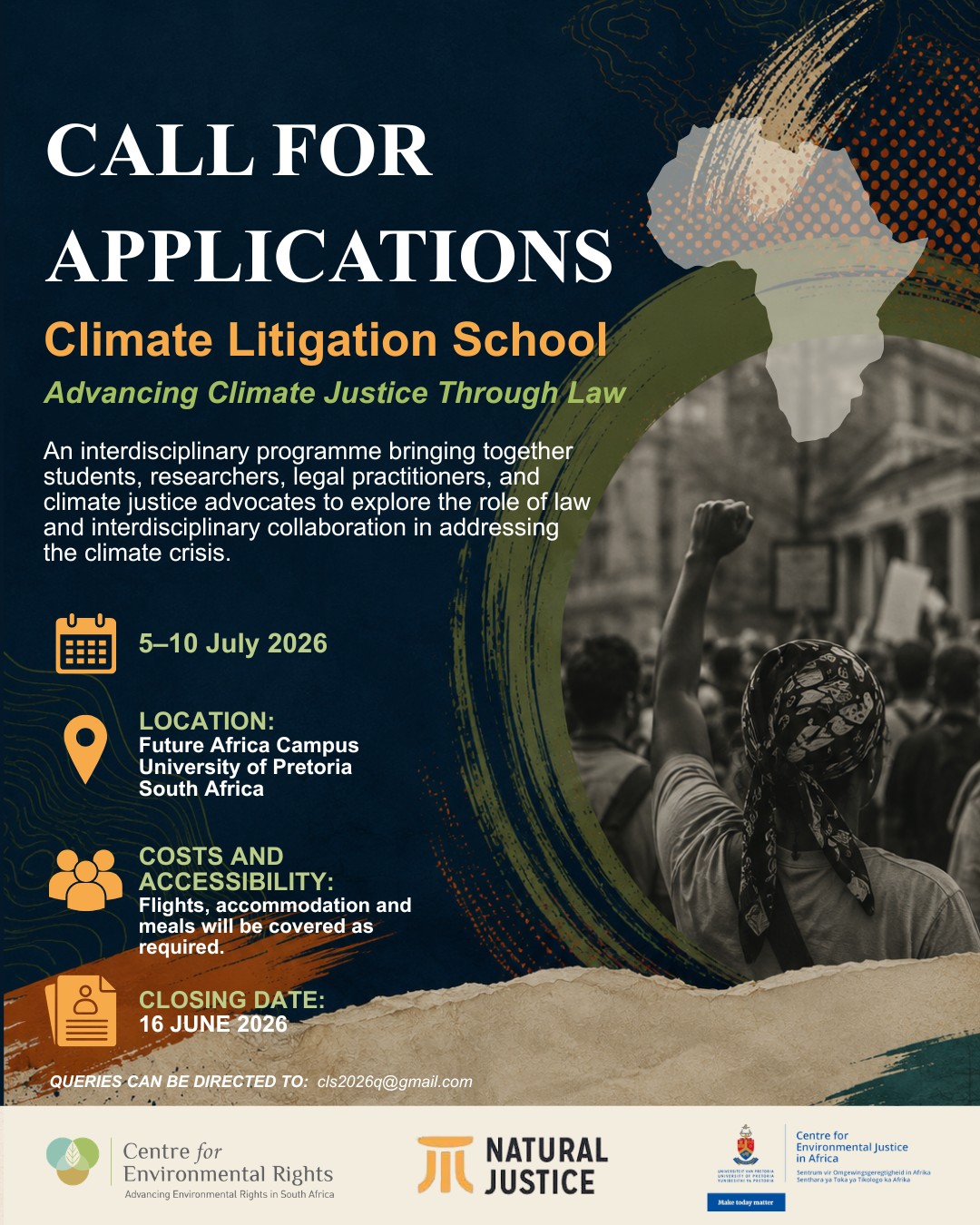
Climate Litigation School Academic Program Overview
- Convening Partners: Natural Justice, the Centre for Environmental Rights (CER), and the University of Pretoria’s Centre for Environmental Justice in Africa (CEJA)
- Program Title: Climate Litigation School 2026
- Academic Framework: Interdisciplinary legal empowerment, climate attribution science integration, and movement lawyering
- Host Venue: Future Africa Campus, University of Pretoria, South Africa
- Program Dates: 5 July 2026 to 10 July 2026
- Financial Model: Fully Funded Fellowship (Covering approved flights, accessibility-mapped accommodation, and all meals)
- Application Closing Window: Tuesday, 16 June 2026
Natural Justice, alongside the Centre for Environmental Rights and the University of Pretoria’s Centre for Environmental Justice in Africa, has opened the international submission window for its specialized mid-year fellowship. Applications are invited from progressive legal practitioners, environmental researchers, public policy analysts, and frontline activists to secure a placement at the upcoming Climate Litigation School. Hosted at the state-of-the-art Future Africa Campus in Pretoria, this intensive residency is engineered to weaponize public interest law, strategic litigation, and community advocacy frameworks against the accelerating climate crisis.
The Climate Litigation School serves as a dedicated, cross-disciplinary laboratory designed to bridge the structural gap between high-level legal expertise and the lived realities of frontline African communities. Moving beyond traditional classroom pedagogy, the Climate Litigation School framework focuses on context-specific training, drawing tactical lessons from landmark global climate cases and rights-based environmental statutes. This intensive program is purpose-built to cultivate a new cohort of movement lawyers and climate litigators equipped to launch transformative legal actions that challenge systemic extractivism.
Core Curricular Themes and Learning Pillars
The educational architecture of the Climate Litigation School balances advanced jurisprudence with empirical science and traditional knowledge systems. Selected participants will engage in exhaustive daily tracks covering three critical intersecting domains:
1. Advanced Climate Litigation Strategies & Rights-Based Frameworks
- Strategic Case Construction: Analyzing the procedural mechanics, jurisdictional boundaries, and pleading requirements of landmark domestic, regional, and international environmental cases.
- Constitutional Rights Mobilization: Leveraging foundational human rights frameworks, environmental justice clauses, and administrative justice acts to challenge carbon-intensive state approvals.
- Movement Lawyering Ethics: Developing the specialized ethical parameters, participatory methodologies, and long-term alliance structures required to support community-led legal actions securely.
2. Climate Attribution Science Integration & Environmental Data Literacy
- Attribution Proofing: Deconstructing climate attribution science to link greenhouse gas emissions from specific corporate or state entities directly to localized ecological damages.
- Data Synthesis: Training legal minds to interpret complex environmental impact projections, carbon budget math, and climate vulnerability maps for presentation in superior courts.
- Expert Witness Coordination: Formulating collaborative workflows between active field scientists and courtroom attorneys to build technically robust, unassailable evidentiary records.
3. Indigenous Knowledge Systems & Communal Ecological Stewardship
- Knowledge Co-Creation: Integrating traditional environmental wisdom and Indigenous ecological stewardship tracking models into formal court submissions.
- Community Sovereignty: Structuring legal empowerment models that ensure frontline communities remain active co-creators of litigation strategies rather than passive clients.
- Resource Governance: Analyzing the complex intersection of customary land tenure rights, extraction concessions, and regional environmental conservation policies.
Participant Eligibility and Selection Framework
The steering committee of the Climate Litigation School invites applications from high-potential individuals based across South Africa and the wider continent who are actively embedded in environmental fields.
Target Applicant Profiles:
├── Law Streams (Postgraduate Students, Public Interest Lawyers, Paralegals)
├── Scientific Streams (Environmental Scientists, Climatologists, Researchers)
├── Policy Streams (Public Policy Analysts, Regulatory Advisors)
└── Grassroots Streams (Climate Justice Activists, Frontline Community Leaders)
Core Selection Criteria:
- Demonstrated Traction: Verifiable pre-existing interest or field experience within climate mitigation, rural environmental protection, or broader human rights advocacy.
- Application Capability: Clear personal commitment and structural capability to deploy the technical competencies gained at the Climate Litigation School directly into active professional assignments or community legal support networks.
- Diversity Imperative: Selection loops will actively prioritize equity, maintaining balanced gender representation alongside explicit racial diversity to reflect the lived demographics of communities most affected by historical environmental injustices.
Also Read: Apply for the Ai Human resources manager & OD Officer vacancy.
Logistics, Financial Funding and Accessibility Guarantees
The institutional organizers are committed to removing financial barriers to ensure elite talent can access the Climate Litigation School curriculum regardless of socio-economic backing.
- Tuition & Enrollment: The complete academic curriculum, workshop materials, digital legal libraries, and field toolkits are 100% tuition-free for all admitted fellows.
- Travel Provisions: Return economy-class domestic or regional flights to Pretoria will be fully organized and covered by the secretariat as required.
- Accommodation & Sustenance: Clean, secure, and wheelchair-accessible accommodation alongside daily meals will be fully provided at the Future Africa Campus for the entire duration of the school.
- Universal Access: All instructional lecture halls, panel spaces, and lodging facilities are built to satisfy strict physical accessibility standards to accommodate participants living with mobility variations comfortably.
Application Guidelines and Submission Protocol
The Climate Litigation School coordination desk manages an independent, peer-reviewed application clearing house. Candidates looking to join this elite 2026 intake must prepare their formal digital dossiers for electronic review.
Required Registration Dossier Components:
- A formal, comprehensive Motivational Statement detailing your direct engagement with environmental or human rights work, why you want to attend the Climate Litigation School, and exactly how you intend to utilize the litigation toolkits to advance climate justice within your region.
- An updated Curriculum Vitae (CV) or Professional Biography tracking your academic background, organizational affiliations, field activations, and current contact information.
- Contact metrics for two professional or academic references capable of verifying your institutional commitment to environmental governance.
Direct Submission and Query Gateway: Compile your motivation letter and CV into a single, high-resolution PDF file. All entry records, formal document submissions, and specialized logistical or curriculum inquiries must be routed via email directly to the central program coordinator at:
Mandatory Electronic Referencing Header: To guarantee your entry clears automated institutional server sort parameters and routes directly to the selection board, your email subject line must read precisely as follows:
Application - Climate Litigation School 2026
Your comprehensive digital dossier must be successfully recorded in the program repository no later than Tuesday, 16 June 2026.
Academic Enrollment Notice: The Centre for Environmental Rights, Natural Justice, and the University of Pretoria enforce a zero-tolerance policy regarding delayed entries. Dossiers recorded past the midnight 2026 UTC closing point, incomplete portfolios missing motivational text, or applications displaying no structural alignment with human rights or climate fields will be archived by the system without consideration. Because space inside the Future Africa residency is strictly capped to foster deep interdisciplinary networking, short-listed finalists will undergo an accelerated remote validation loop to confirm their fully funded travel itineraries.
Disclaimer: The Business Pulse shares verified opportunities from trusted sources. We are not a recruiting agency and do not request any payment for applications.
Leave a Reply